


Last updated:
What platform choice actually determines for a regulated eCommerce niche
Every peptide brand that comes to us eventually asks the same question: “Can’t we just start on Shopify and move later if it becomes a problem?” The honest answer is no not because Shopify is a bad platform, but because it doesn’t allow this product category at all. Understanding why changes how you should think about platform choice from day one.
At Vann Creations, every peptide research website we’ve built runs on WordPress with WooCommerce. Not as a default preference, but because it’s the only mainstream platform that lets a peptide store actually stay online long-term. Here’s the reasoning behind that, in plain terms.
The Comparison Most Articles Get Wrong
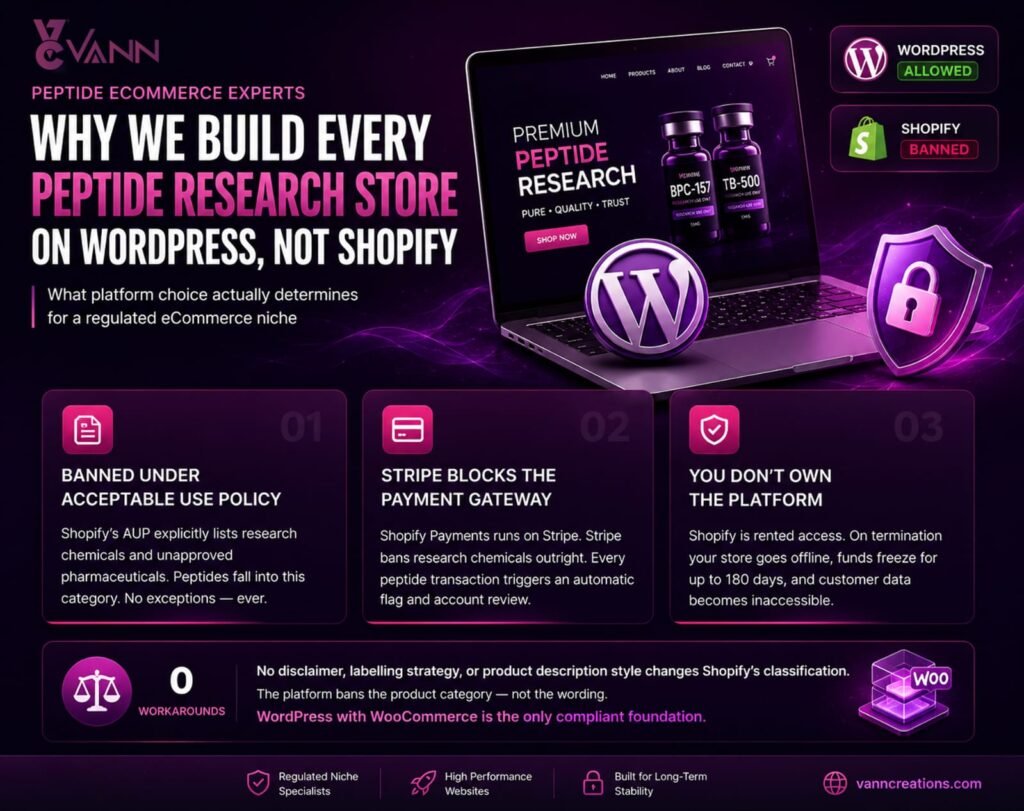
Typical “WordPress vs Shopify” content frames the decision around ease of use, design flexibility, or monthly cost reasonable questions for most businesses. For a peptide brand, that framing skips the one fact that actually decides the outcome: Shopify’s Acceptable Use Policy prohibits merchants from selling drug-related products and unapproved pharmaceutical or research-chemical items, and peptides are consistently placed in that category regardless of how the product is worded, disclaimed, or age-gated.
Once that’s understood, this stops being a comparison of two similar options and becomes a much simpler question: which platform will actually let the store operate?
Ownership: Renting a Storefront vs. Owning One
Shopify is a subscription service. You’re granted access to the platform for as long as you comply with its terms and that access can be revoked at any time if a product category is judged to violate policy. For peptide sellers, that’s not a rare, worst-case scenario. It happens routinely, and the aftermath tends to look the same each time:
- The storefront is taken offline immediately, with no advance notice to the merchant
- Funds held in Shopify Payments are frozen, commonly for 90–180 days, while the account is reviewed
- Order history and customer records become inaccessible
- A second attempt under a new account with the same products is typically flagged and closed faster than the first
WordPress operates on the opposite model. It’s open-source software installed on hosting the merchant controls. There’s no company positioned to revoke access to your own site if a hosting provider ever stopped working out, the installation simply moves elsewhere, with no interruption to the business itself.

Payment Processing: The Second Wall Behind the First
Even if Shopify’s own policy weren’t an issue, there’s a second obstacle underneath it. Shopify Payments runs on Stripe’s infrastructure, and Stripe’s Prohibited and Restricted Businesses list excludes illegal drugs and substances designed to mimic them, along with a broader category covering unapproved pharmaceutical and research-chemical products. Peptide transactions are routinely caught by this.
That means a peptide store on Shopify faces two separate prohibitions pointed the same direction: the platform’s own policy, and its built-in payment processor’s policy. Connecting a third-party gateway doesn’t resolve this — the Acceptable Use Policy violation exists at the platform level, independent of who’s actually processing the transaction.
WordPress with WooCommerce doesn’t tie a store to one processor. Merchants can connect specialist high-risk payment gateways built specifically to underwrite research-chemical and peptide businesses processors that evaluate the category properly instead of auto-rejecting it.
Compliance Architecture Needs Real Control, Not a Workaround
Getting approved by a high-risk payment processor depends heavily on how the website itself is structured. Underwriters generally look for:
- A research-use-only disclaimer that’s clearly worded and linked from every product page, the footer, and checkout
- An age verification step that activates before any product content becomes visible
- Terms and conditions written specifically for research-chemical sales, not adapted from a generic store template
- Certificates of Analysis (COAs) displayed per product and linked to independent lab verification
- Checkout confirmations that reinforce research-only intent before a payment is processed
- Product descriptions written in research-compound language, without consumer-facing health claims
On WordPress, all of this can be built to exact specification, because there’s full control over page structure, checkout flow, and every compliance element an underwriter reviews. Shopify restricts how deeply merchants can customize checkout and compliance pages a limitation that matters little for a typical retail store, but becomes a real obstacle for one operating in a regulated category.
Platform Comparison at a Glance
| Shopify | WordPress + WooCommerce | |
| Peptide / research-chemical products allowed | No prohibited under the Acceptable Use Policy | Yes no platform-imposed product restriction |
| Who owns the platform | Shopify; access is revocable | The merchant; self-hosted and fully owned |
| Built-in payment processor | Shopify Payments (Stripe); restricts research chemicals | None any gateway can be integrated |
| Control over checkout and compliance pages | Limited by platform and theme restrictions | Full control over structure and content |
| Termination risk for this category | Real, and recurring | Not applicable |
| Technical setup effort | Lower | Higher, but manageable with the right build |
A Quick Note on Other Platforms
BigCommerce doesn’t carry an explicit peptide ban, but still routes through third-party processors applying the same high-risk restrictions it removes the platform-termination risk without fully solving the payment problem.
Shift4Shop allows some categories Shopify won’t, but its plugin and theme ecosystem is far smaller than WordPress’s, limiting how precisely the compliance architecture can be built.
Fully custom builds offer maximum control with no platform restrictions, but at a cost that’s difficult to justify for most peptide brands when WordPress with WooCommerce delivers comparable control for significantly less investment.
What Actually Makes a WordPress Peptide Store Work
Choosing WordPress solves the platform-eligibility problem. It doesn’t automatically solve underwriting that comes down to how the site is actually built. A properly structured store typically includes:
Managed hosting suited to regulated eCommerce. COA files are often large PDFs, catalogs can be extensive, and reliable uptime matters while a payment processor is actively reviewing the site. Shared or budget hosting isn’t built for this load.
Compliance treated as structural, not decorative. The disclaimer, age gate, and terms of service need to be genuine parts of the site’s architecture visible where an underwriter will actually look, not tucked into a footer link.
A WooCommerce setup built around research-only purchasing. That includes checkout confirmations, COA and purity data on every product page, and category/URL structures that support both compliance review and search visibility.
A payment gateway relationship in place before launch, not something scrambled together after the store is already live.
Thinking About Migrating or Building Fresh?
If a peptide store is currently running on Shopify and hasn’t been flagged yet, moving proactively is far less disruptive than migrating after a termination forces the issue. If it’s already happened, the data and content can typically be recovered and rebuilt on a foundation actually designed for this category.
Vann Creations builds peptide research websites on WordPress and WooCommerce with compliance architecture, high-risk payment gateway integration, and SEO strategy designed in from the first page of the build. Book a call or get in touch to talk through what a compliant, durable peptide store looks like for your brand.
Frequently Asked Questions
Can peptides be sold on Shopify? No. Shopify’s Acceptable Use Policy prohibits drug-related and unapproved pharmaceutical or research-chemical products a category peptides are consistently placed in regardless of labeling. Stores that attempt it are commonly terminated, sometimes with funds frozen for months.
Does switching payment gateways on Shopify solve the issue? No. The Acceptable Use Policy violation exists at the platform level, independent of which payment processor is connected.
Why does WordPress work better for this category? Because the merchant owns the platform outright nothing can revoke access and has full freedom to select a payment gateway built for high-risk, research-chemical businesses, along with complete control over the compliance architecture underwriters expect.
Is WordPress more difficult to set up than Shopify? Generally, yes, from a technical standpoint. But since Shopify doesn’t permit this product category at all, comparing setup difficulty isn’t really the relevant question.
Can an existing Shopify peptide store be migrated to WordPress? Yes. Products, content, and existing SEO value can typically be carried over, alongside rebuilding the compliance architecture, integrating a high-risk payment gateway, and using redirects to preserve search rankings.