

Imagine starting your day only to find that your Shopify store has been suspended, your payment processing privileges have been revoked, or you’ve received a policy violation notice with little explanation and no clear recovery path.
For many peptide research businesses, this situation is becoming increasingly common. Whether your store has already been affected or you’re concerned about future enforcement, understanding Shopify’s policies and preparing a recovery strategy is critical.
At Vann Creation, we’ve worked with peptide research brands across the United States, the United Kingdom, and other international markets. Through years of experience building, optimizing, and migrating peptide-focused eCommerce websites, we’ve seen firsthand how platform restrictions can impact business owners. More importantly, we’ve helped businesses recover, rebuild, and establish long-term stability on platforms better suited to their needs.
Key Takeaways 1-Shopify’s policies place significant restrictions on peptide-related products, regardless of how they are marketed or labelled. 2-Store reviews can be triggered through automated scanning systems, payment processor reviews, manual compliance audits, and external reports. 3-A suspension may result in immediate storefront removal, restricted payment access, loss of platform privileges, and disruption to business operations. 4-Labels such as “Research Use Only” or “Not for Human Consumption” do not automatically exempt products from platform policy reviews. 5-Many peptide businesses choose WordPress and WooCommerce because they offer greater ownership, flexibility, and long-term control. 6-Successful migration requires proper planning, compliance-focused website architecture, secure payment processing, and SEO preservation strategies. |
| Table of Contents Understanding Shopify’s Policy on Peptides How Shopify Identifies Peptide Stores The Business Impact of Store Suspension Why Research-Only Disclaimers May Not Be Enough, What to Do If Your Store Is Suspended |
Running a peptide research business requires more than a functional website. It requires a platform that aligns with your business model, supports compliance requirements, and allows you to maintain control over your operations. Understanding the risks associated with platform restrictions is the first step toward building a sustainable online presence.
Understanding Shopify’s Policy on Peptide Products
Many store owners assume that research-use-only language, compliance notices, or carefully written product descriptions will protect their business from platform enforcement. Unfortunately, this assumption often leads to unexpected account reviews and suspensions.
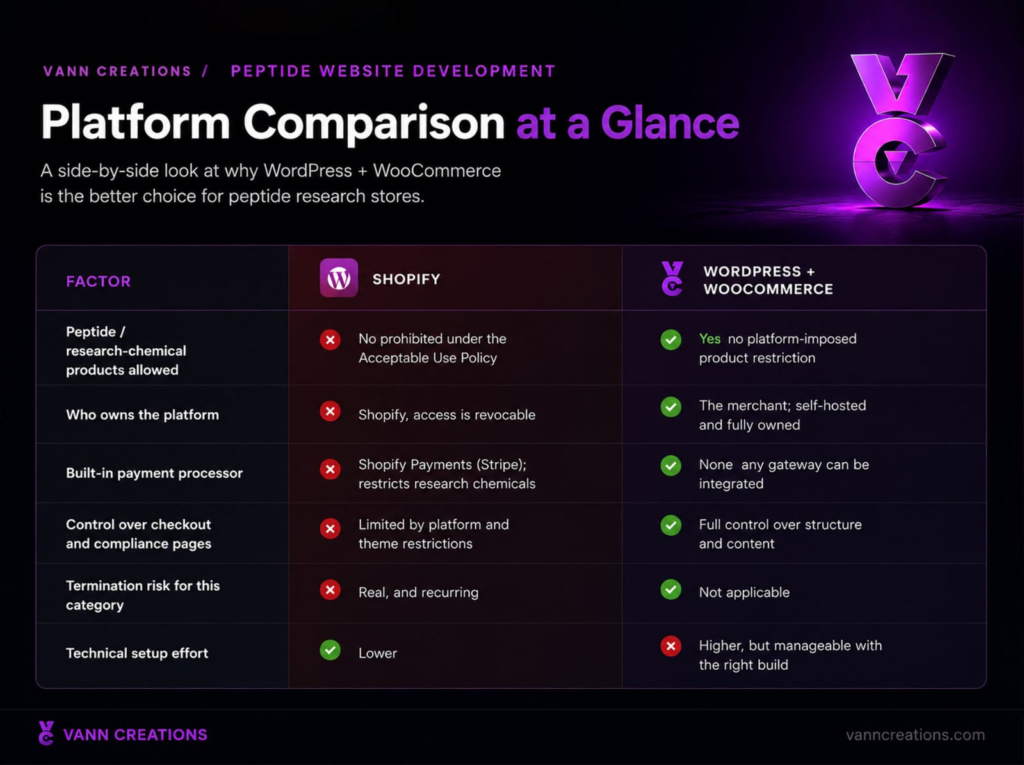
Shopify evaluates businesses based largely on the nature of the products being sold rather than solely on the wording used throughout the website. As a result, products that fall within regulated or restricted categories may attract additional scrutiny regardless of how they are presented.
According to Shopify’s platform guidelines, categories that commonly face restrictions include:
- Regulated pharmaceutical products and medical devices
- Unapproved health-related products
- Certain research chemicals and laboratory compounds
- Nutraceuticals making therapeutic or medical claims
- Products requiring regulatory approval before commercial sale
Because peptide products can overlap with these categories, many peptide-focused businesses encounter compliance challenges while operating on the platform.
Why This Creates Challenges for Peptide Sellers
One of the biggest misconceptions among store owners is that a research-use-only disclaimer automatically changes how a product is classified. In reality, platform reviews often focus on the product category itself rather than the disclaimer language used on the website.
This means that even businesses that implement age verification, research disclaimers, and compliance-focused product pages may still face account reviews if their products fall within categories that Shopify considers high risk.
Insights From Industry Experience
At Vann Creation, we have worked with peptide research businesses serving customers in multiple countries. One common pattern we have observed is that businesses relying solely on disclaimers often underestimate the importance of platform-level policies.
Some stores operate for months without issues, while others encounter reviews much sooner. However, the timing of enforcement does not necessarily indicate compliance. It often reflects when a platform review, payment processor assessment, or policy audit occurs.
Understanding these realities allows business owners to make informed decisions before a disruption affects their operations.
How Shopify Identifies Peptide Stores
One of the most common misconceptions among peptide business owners is that a store is safe if it has been operating for several months without receiving any warnings. In reality, the timing of a review often depends on when Shopify’s systems, payment partners, or compliance teams evaluate the website.
Some stores may face scrutiny shortly after launch, while others operate for an extended period before a review occurs. Understanding the most common review triggers can help business owners better understand the risks involved.
Automated Product and Content Scanning
Like many large eCommerce platforms, Shopify uses automated systems to analyze website content. Product titles, descriptions, metadata, collection pages, and other store content may be reviewed for keywords associated with restricted product categories.
Terms commonly associated with peptide research products, laboratory compounds, or research chemicals may attract additional attention during automated reviews. Product names, ingredient references, and certain compliance-related phrases can all contribute to a store being flagged for further evaluation.
While automated tools are designed to improve platform compliance, they are only one part of the review process.
Payment Processor Monitoring
Payment processors play a major role in compliance reviews. Shopify Payments relies on external payment infrastructure that conducts its own risk assessments and category evaluations.
When a business falls into a high-risk category, payment processors may initiate additional reviews to ensure compliance with their policies. In some cases, these reviews can result in requests for documentation, temporary restrictions, or account investigations.
Even businesses that use alternative payment gateways may still be subject to platform-level policy reviews, making payment processing only one piece of the overall compliance picture.
Manual Compliance Audits
Automated systems are often followed by manual reviews conducted by trust and safety teams or compliance specialists.
During a manual audit, reviewers may examine:
- Product pages
- Collection and category pages
- About Us content
- Policy pages
- Footer links
- Checkout processes
- Marketing claims and website language
The purpose of these audits is to determine whether a store complies with platform policies and risk-management requirements.
Reports From External Sources
Another common trigger is third-party reporting.
Competitors, customers, industry watchdogs, and regulatory organizations can submit reports that lead to additional reviews. A single report may prompt Shopify to investigate a store’s products, content, and compliance practices.
Although not every report results in enforcement action, external complaints often accelerate the review process.
Why Store Age Doesn’t Guarantee Safety
Many business owners mistakenly assume that operating for several months without issues means their store has passed compliance requirements.
In reality, the length of time a store remains active is not a reliable indicator of policy compliance. It often reflects when a review is initiated rather than whether the business falls within a restricted category.
This is why relying on timing alone can create a false sense of security. Businesses should focus on building a sustainable long-term strategy rather than assuming an absence of warnings means there is no risk.
The Business Impact of a Shopify Suspension
Many business owners assume that a platform suspension simply means losing access to their storefront. In reality, the consequences can extend far beyond website downtime and may affect revenue, customer relationships, marketing efforts, and overall business continuity.
The impact is often immediate and can require significant time and resources to recover from.
Loss of Storefront Access
One of the first consequences of a suspension is the removal of access to your online store.
Customers may suddenly be unable to:
- Browse products
- Complete purchases
- Access account information
- Track existing orders
This interruption can create confusion among customers and lead to lost sales opportunities.
Payment Processing Disruptions
For many businesses, payment processing interruptions create the most urgent challenge.
Funds associated with pending transactions may become temporarily unavailable while reviews are conducted. Depending on the circumstances, access to those funds may be delayed for an extended period.
This can place significant pressure on cash flow, particularly for businesses that rely heavily on online sales as their primary revenue source.
Customer Data Accessibility Concerns
Customer information is one of the most valuable assets an online business owns.
When platform restrictions occur, access to:
- Customer lists
- Order histories
- Purchase records
- Marketing data
may become more difficult if independent backups are not maintained.
Businesses that regularly export and secure their data are generally better positioned to recover quickly.
Brand Reputation Challenges
Unexpected store downtime can impact customer confidence.
Visitors who encounter unavailable pages, failed checkout experiences, or inactive websites may question the reliability of the business. Maintaining communication with customers during disruptions is often essential for preserving trust and loyalty.
Rebuilding Costs
Recovering from a suspension often involves more than simply launching a new website.
Businesses may need to:
- Rebuild website infrastructure
- Reconfigure payment processing
- Migrate product data
- Restore SEO performance
- Re-establish customer communication channels
These tasks require time, planning, and investment.
| Why Preparation MattersAt Vann Creation, we’ve found that businesses with strong backup procedures, documented processes, and migration plans recover significantly faster than those relying entirely on a single platform.Preparing in advance can reduce downtime, protect valuable business assets, and minimize the long-term impact of unexpected platform restrictions. |
Why Research-Only Disclaimers May Not Be Enough
One of the most frustrating experiences for peptide business owners is receiving a suspension notice despite investing significant effort into compliance measures.
Many store owners implement research-use-only disclaimers, age verification systems, detailed terms and conditions, and carefully written product descriptions. When enforcement action still occurs, the first reaction is often confusion.
The reality is that platform policies and website compliance are not always evaluated in the same way.
Understanding the Difference Between Compliance and Platform Policy
A disclaimer can help communicate how products should be used and may support broader compliance objectives. However, a platform’s internal policies may focus primarily on the category of products being offered rather than the wording displayed on the website.
This distinction is important because many business owners assume that adding the correct disclaimer automatically resolves platform concerns. In practice, disclaimers and platform policies often address different issues.
Common Measures That May Not Prevent Platform Reviews
Businesses frequently rely on the following elements:
- Research-use-only notices
- “Not for human consumption” statements
- Age verification pop-ups
- Product usage disclaimers
- Carefully worded product descriptions
- Alternative payment gateways
While these measures can be important for operational and compliance purposes, they do not necessarily guarantee protection from platform-level policy reviews.
Why Product Classification Matters
Many platforms evaluate risk based on the products themselves rather than solely on marketing language.
For example, removing benefit claims or adding additional warnings does not automatically change how a product category is assessed during a compliance review.
As a result, businesses sometimes discover that even highly detailed compliance pages do not eliminate platform concerns if the underlying product category remains subject to additional scrutiny.
Compliance Still Has Value
This does not mean compliance measures are unnecessary.
Properly structured disclaimers, age verification systems, privacy policies, terms and conditions, and research-focused language remain important components of a professional peptide research website.
These elements can support customer transparency, payment processor reviews, and overall business credibility.